Websites for Contractors, Medical Practices & Real Estate in Phoenix
What contractor, medical/dental, and real estate websites each actually require — service-area pages, HIPAA-aware intake, IDX listings — and what generic agencies get wrong.
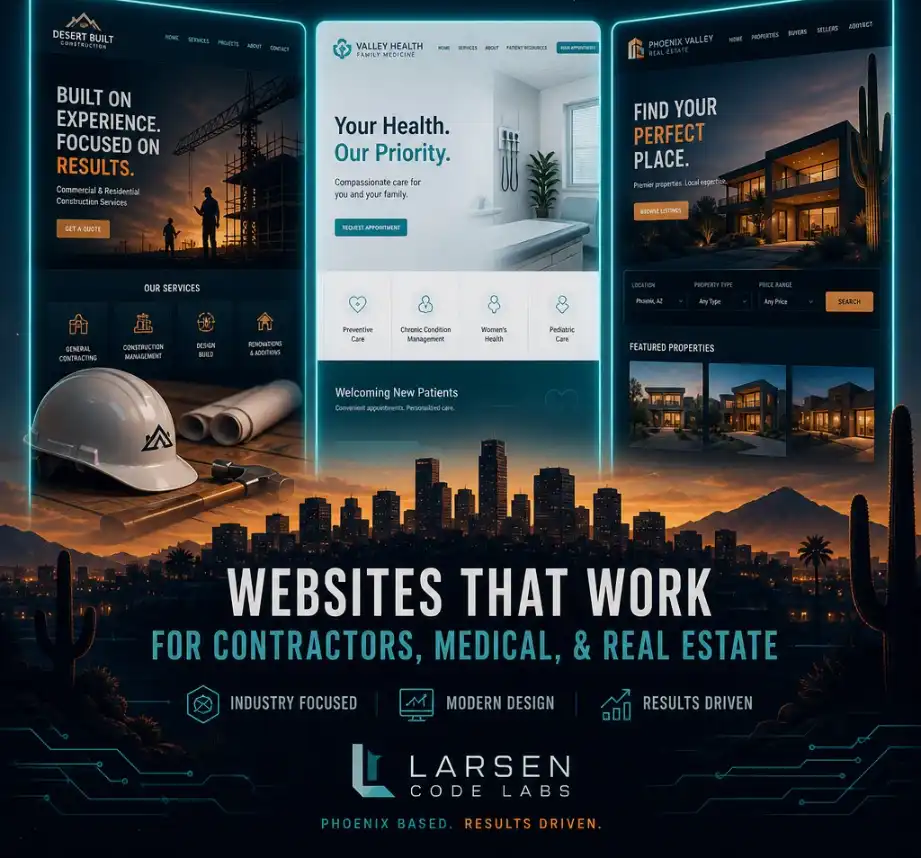
What contractor, medical/dental, and real estate websites each actually require — service-area pages, HIPAA-aware intake, IDX listings — and what generic agencies get wrong.
"Small business website" is a phrase that hides more than it explains. A roofing company, a dental practice, and a real estate team are all small businesses — and the right website for each one is different in structure, in legal obligations, and in what actually generates customers. Agencies that sell one template to all three deliver a site that half-works for everyone.
This guide covers the three verticals we're asked about most in our Phoenix web design work, and what each genuinely requires.
For contractors — roofing, HVAC, plumbing, electrical, landscaping, remodels — the website has one job: convert a homeowner mid-problem into a quote request. Everything serves that.
Service-area architecture. Home services businesses win local search city by city. That means real pages for the cities you serve, each with substance — not a footer list of twenty city names, which search engines learned to ignore years ago. (It's the same discipline behind our own Scottsdale, Tempe, and Mesa pages — we practice what we're prescribing here.)
Trust signals in the first screen. In Arizona, that starts with your ROC license number displayed plainly — homeowners are told to check it, so make it checkable. Add insurance, years operating, and reviews pulled onto the site itself.
Proof organized by job type. Photo galleries labeled "Gallery" waste the best asset a contractor has. Organize before/after work by service — roof replacements, panel upgrades, backyard remodels — so the homeowner finds their problem, solved.
A quote path that respects the phone. Big tap targets, a short form (name, city, problem, photos-optional), and a phone number that dials on tap. Every added field measurably drops submissions.
Scheduling and follow-up wiring. The contractors winning online aren't just capturing quote requests — they're responding first. Integration with your scheduling or field-service software (or a simple booking flow when you don't run one) plus automated estimate follow-up turns the site from a brochure into the front end of your pipeline. When that follow-up layer uses AI to read and draft, it's exactly the intake automation we build — websites and automation meet precisely here.
The mistake we fix most in this vertical: the twenty-city footer list standing in for real service-area pages, and a gallery of unlabeled photos standing in for organized proof. Both feel like coverage; neither converts nor ranks.
Practice websites carry obligations the other verticals don't, and the failures are usually invisible until they're expensive.
Intake is where compliance starts. The marketing pages of a practice site are just pages — but appointment requests, new-patient forms, and any chat feature collect protected health information. Those flows need encrypted transmission and storage, vendor agreements with whoever processes the data, and deliberate decisions about what analytics runs on patient-facing pages. The most common mistake we find: a standard contact-form plugin emailing patient details in plain text, with an ad pixel watching the page. This is engineering-adjacent territory, which is why practices tend to hire a company that also builds software rather than a design shop.
Booking that meets patients where they are. Patients booking care are often stressed, on a phone, between obligations. Online scheduling — integrated with the practice management system where possible — converts patients who will not call during office hours.
Accessibility is non-optional. Healthcare audiences span every age and ability; WCAG basics (contrast, text sizing, keyboard navigation, alt text) are both the right thing and increasingly a legal-exposure issue for practices.
Structured provider data. Physician profiles, specialties, locations, and hours marked up so search engines — and, increasingly, AI assistants answering "dentist near me who does X" — can read them accurately.
The review economy, handled carefully. Healthcare reviews carry both outsized weight and regulatory sensitivity — responding to a review must never confirm someone was a patient. Practice sites should surface ratings and make review-leaving easy, while staff responses follow a privacy-safe script. It's a small operational detail that generic web designers never flag and practices get quietly burned by.
Real estate sites live or die on a question the other verticals never face: why would anyone use your site instead of the big portals?
IDX/MLS integration answers it. IDX (Internet Data Exchange) puts live MLS listings and search on your site under MLS rules. Done well, the visitor searches on your site — with your branding, your saved-search alerts, and your lead capture — instead of becoming a portal's lead that gets sold back to you.
Neighborhood authority is the durable asset. Listing data is a commodity; genuinely local pages are not. Area guides with real substance — schools, commute realities, what $600K buys in this zip versus that one — earn search standing the portals can't localize and give buyers a reason to come back.
Speed with heavy media. Real estate is image- and map-heavy, the exact ingredients of a slow site. Modern image formats, lazy loading, and disciplined scripts keep listing pages inside Core Web Vitals thresholds — a genuine ranking and experience edge, since most agent sites fail them.
Lead routing that matches how teams work. Buyer inquiries, seller valuation requests, and open-house sign-ins each need to land in the CRM correctly attributed — integration work that's routine for us and mysteriously rare in this vertical.
Response speed as the actual differentiator. Real estate leads decay by the minute — the agent who responds first usually gets the client, and portal leads go to whoever answers. A site wired for instant, personalized first response (which is an automation build sitting on top of the website) converts the same traffic materially better than one that emails a shared inbox. In this vertical more than any other, the website and the follow-up system are one machine, and building them separately wastes both.
Step back from the specifics and one principle explains every section above: each vertical's customers arrive with expectations trained by every other site in that vertical, and violating them costs trust even when your version is "better." A homeowner expects to find a license number and photos of work like theirs; a patient expects online booking and insurance information; a buyer expects to search listings on the spot. Meeting the convention is table stakes; the differentiation happens in execution quality — speed, clarity, and the local specificity generic agencies can't fake.
This is also why "we'll use our proven template" from a national agency should worry you: their template encodes no vertical's conventions properly, because it was built to sell to all of them. The productive question for any agency, us included: show me how your build handles the three things my industry's customers always look for. An agency that can't name those three things for your vertical is learning on your invoice.
Two verticals we're asked about that didn't get sections — restaurants (the requirements are a fast HTML menu, hours that Google can read, and one-tap ordering/reservation paths; most of the Tempe page's mobile discipline applies directly) and professional services (law, accounting, consulting — where the site is a credibility document and the Scottsdale page's restraint principle governs). If your industry isn't named anywhere on this page, the conventions-first method still is the answer: we start by mapping what your customers expect, then engineer past it.
Industry sites price on our published ranges — $5,000–$15,000 covers most contractor and practice sites; real estate with IDX and custom search typically lands mid-to-upper range; deep integrations (practice management systems, CRM routing, custom portals) move a project toward software territory, quoted as such with a signed Statement of Work either way.
ROC license number, real service-area pages, job-type-organized proof, surfaced reviews, and a short mobile-first quote form. In that order of importance.
Standard timeline applies — 2–5 weeks — with one vertical wrinkle: medical sites add lead time for compliance review of intake flows, and IDX approvals from the MLS run on the MLS's clock, so real estate builds start that paperwork at kickoff. We sequence the slow-permission items first so they never become the launch blocker.
Because your site will be structurally identical to every competitor's — same layout, same stock copy patterns, same conversion ceiling — and identical sites can't outrank or out-convert each other on anything but ad spend. Template providers are fine floors; they're just not differentiation, and in crowded Phoenix verticals differentiation is the entire game.
The obligations attach where patient information flows — intake, booking, chat. Those flows need appropriate safeguards and vendor agreements; the mistake is treating them like ordinary web forms.
Usually yes, if paired with real neighborhood content — IDX alone makes you a worse portal, IDX plus local authority makes you the local answer. Team economics make it a clearer yes.
Yes — redirect mapping and structural care preserve search equity through a redesign; it's a standard part of how we build.
Same published base — $5,000–$15,000 — with the vertical features moving position inside it: contractor service-area architecture sits low-to-mid; medical sites with compliant intake and booking integration sit mid-to-upper; real estate with IDX sits mid-to-upper plus the IDX vendor's own fees (typically $30–$100/month, paid to them, not us). Anything requiring deep systems integration gets quoted as the software project it honestly is.
Structurally, yes — location pages become the backbone, brand consistency constraints apply, and review management multiplies. The conventions-first method holds; the architecture gets a location dimension. Worth a specific conversation rather than a generic quote.
In one of these industries with a site that underperforms? Tell us which vertical and what's not working — we'll give you the specific gaps and a real quote. Get in touch.