AI Automation vs. Traditional Automation (RPA): The Real Difference
RPA and rules-based automation vs. AI automation, explained honestly — when the cheap rules-based tool is the right answer, and when AI genuinely earns its keep.
RPA and rules-based automation vs. AI automation, explained honestly — when the cheap rules-based tool is the right answer, and when AI genuinely earns its keep.
"Is RPA actually AI?" is the rare vendor-vocabulary question worth asking, because the answer decides real money: rules-based automation and AI automation solve different problems at different prices, and buying the wrong one is the most common way businesses sour on automation entirely.
Short answer up front, then the useful detail — this is the technology-boundary chapter of our AI automation guide.
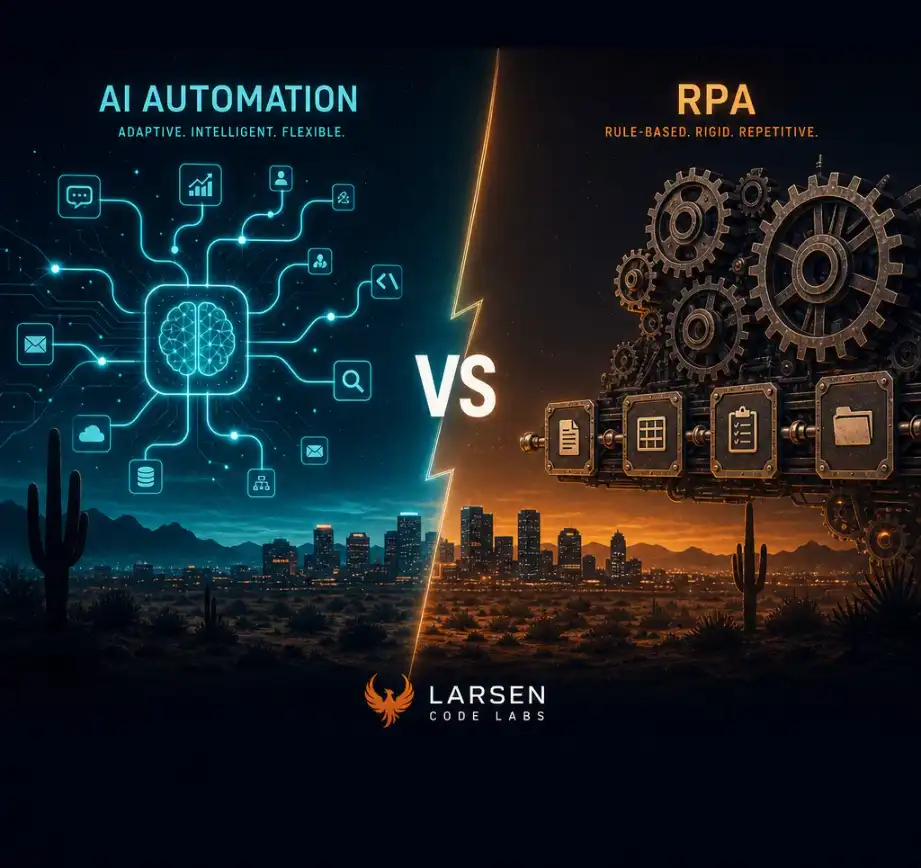
RPA — robotic process automation — is not AI. It's pre-written rules executed on predictable input: open this screen, copy this field, paste it there, click submit. No understanding occurs; the "robot" is a script. AI automation uses models (LLMs) that interpret: read a rambling email, judge what it is, extract what matters, draft what comes next. RPA executes. AI interprets. That's the entire distinction.
Everything practical follows from it:
A vocabulary note while we're here: the RPA label mostly lives in enterprise sales decks. In small-business practice, "rules-based automation" means tools like Zapier and Make and plain integration code — same principle, saner prices. And agentic AI — the newer term — is AI given a goal and freedom to choose its own steps; more on where that fits below.
Rules-based automation is the correct, boring, reliable answer whenever input is structured and logic is exact:
If a competent employee could write the complete instructions on an index card — no "it depends" — it's a rules job. Using an LLM for it is renting a reader for material that never needs reading: extra cost, extra latency, and a new way to be wrong, in exchange for nothing. A vendor pitching "AI" for index-card work is selling the label, not the fit — one of the failure patterns catalogued in where AI automation goes wrong.
AI earns its cost exactly where the index card fails — where the instructions contain "read it and figure out...":
And the honest architecture — the one we build — is almost always both: rules for the plumbing (triggers, syncs, notifications), AI at the specific junctions that need reading, judgment, or writing, humans on the exceptions. Agentic patterns enter when the workflow genuinely varies case to case and a fixed sequence can't be drawn in advance; they're powerful there and pure overhead everywhere else.
The rule of thumb that prices it: rules where rules suffice, AI where interpretation begins, humans where stakes concentrate. Systems built on that line cost less and fail better than either purist approach.
No — RPA is scripted execution with no interpretation. The confusion is commercial: RPA vendors added "AI-powered" to labels as LLMs arrived. Ask what interprets the input; if nothing does, it's rules.
At small-business scale, enterprise RPA suites are rarely the answer — connector tools (Zapier/Make) and integration code cover the rules layer at a fraction of the cost. Which one, and when connectors run out of headroom, is covered in our workflow automation guide.
The index-card test, step by step: any step whose instructions fit on a card is rules; any step whose instructions start with "read it and decide" is AI; any step where a mistake is expensive keeps a human. That mapping is literally the first deliverable of our AI audit.
That's the normal architecture, not the exception: rules move the data, AI interprets the messy step, rules resume on the structured result. The intake example runs exactly this way — a rules trigger on email arrival, AI for reading and drafting, rules for the CRM write and notification.
Only where workflows genuinely vary case to case. Most small-business automation is better served by the hybrid above — and a vendor leading with "agents" before understanding your workflow has the order backwards.
Not sure which category your bottleneck falls in? Describe the workflow — we'll tell you which steps are rules, which are AI, and which should stay human, before any money moves. Ask us, or return to the full AI automation guide.