Where AI Automation Actually Goes Wrong
The failure modes that waste AI automation budgets — automating broken processes, no human fallback, ignored data privacy — and how each one is engineered against.
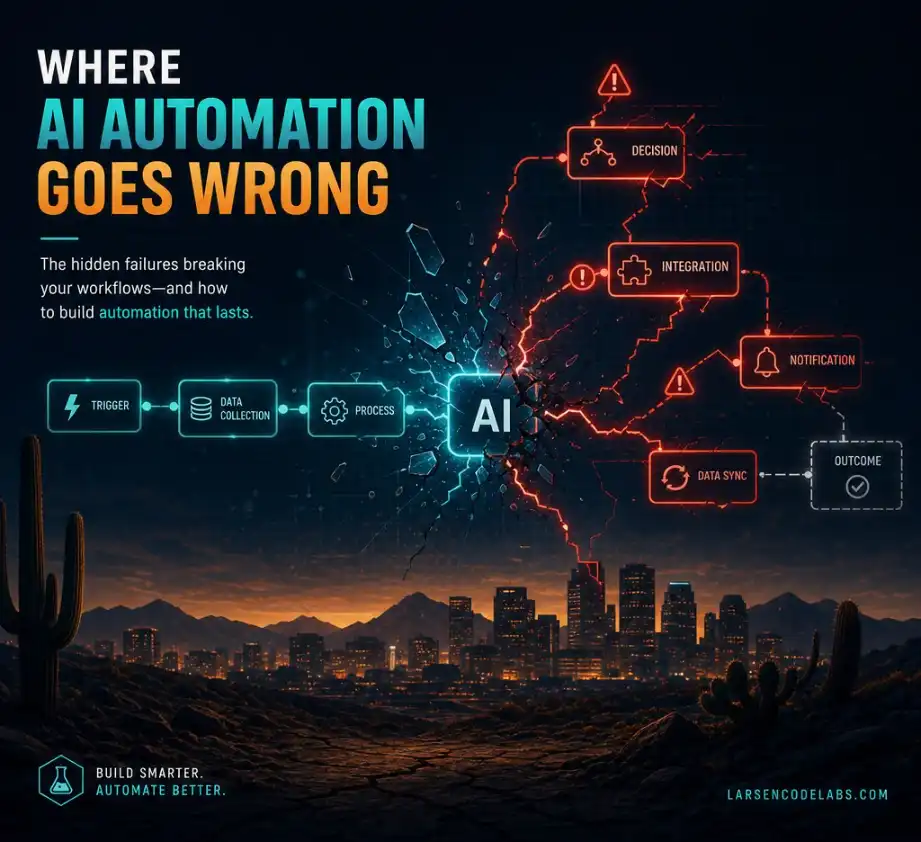
The failure modes that waste AI automation budgets — automating broken processes, no human fallback, ignored data privacy — and how each one is engineered against.
We sell AI automation, and this page catalogs the ways it fails. That's not a contradiction — it's the sales filter working as intended: businesses that understand the failure modes buy better projects, and better projects are the only kind worth building. Every pattern below comes from real wreckage — systems we've been asked to fix, or engagements we declined because the failure was pre-ordered.
Consider this the immune system of our AI automation practice.
The most common failure and the most expensive, because it succeeds technically. The intake process misroutes half its inquiries; the follow-up sequence sends the wrong message to the wrong segment; the data being moved between systems was never clean. Automate that, and you've built a machine that produces the same garbage without the human pause that used to occasionally catch it.
The tell in the sales conversation: "our process is a mess — that's why we want to automate it." Automation doesn't fix a mess; it ships it, on schedule, at volume.
The defense: fix, then automate. Sometimes the fix is small — a week of process cleanup before the build. Sometimes it reveals the real project is process design and the automation should wait, which is exactly the kind of finding our audit is paid to deliver, and one of the "not yet" signals in the readiness guide.
LLMs are probabilistic: overwhelmingly right on the patterned cases, occasionally wrong with total confidence. A deployment designed as if the error rate were zero converts that occasional wrongness into customer-facing damage — the misrouted complaint, the confidently incorrect price, the angry email answered cheerfully.
The failure isn't that the AI erred; it's that nothing was designed to happen when it did.
The defense — designed, not hoped: confidence thresholds that route uncertain cases to a review queue instead of guessing; escalation triggers on stakes (anger, money, ambiguity → human, with context attached); approval steps on outbound actions that matter (drafts queued, not auto-sent, until trust is earned in production); and logs of every automated action, so "what did it do and why" always has an answer. Every build we ship carries all four — it's why our chatbots hand off and our workflows queue drafts by default.
The quiet one, discovered late. Business data — customer records, medical details, financials — flows into an automation, and nobody asked: which model sees this, under what terms, stored where? Consumer AI tools with training-by-default terms, sensitive fields passed wholesale when a fragment would do, credentials granted at admin scope because it was easier — none of it fails visibly until the day it fails very visibly.
The defense is architecture: API access under terms that exclude training on your data (the standard for serious API use — and the reason "we just use the free chatbot" is not an automation strategy); data minimization — the model sees what the task needs, not the record; sensitive data staying in your systems, referenced rather than shipped, wherever possible; least-privilege credentials; and audit logs. For regulated corners — health information, payments — the bar rises further, and the honest move is designing to it from day one rather than retrofitting after the letter arrives.
Three more, briefly, because they cluster around the big three:
Read the list again and notice what's absent: the AI being insufficiently smart. Automation failures are overwhelmingly selection failures (wrong process), engineering failures (no fallback, no privacy design, no operation plan), and management failures (no owner, no adoption). All preventable — none by the model, all by the build. Which is the case, made honestly, for buying automation from engineers rather than from enthusiasm: the model is rented; the discipline is what you're actually hiring. It's the same discipline we point at our own products, where the failure modes above would cost us our own revenue first.
Automating a broken process. It's the failure that looks like success longest — the system runs, the demo impresses, and the garbage ships faster than ever.
Describe it out loud with the people who run it. If the description keeps forking into "well, unless..." and the forks contradict each other, fix first. Mild messiness is fine — AI tolerates messy input; it can't supply missing intent.
The privacy one — data that leaked into the wrong place can't be un-leaked, which is why it's the failure we design against first rather than most. Everything else on this page is expensive but reversible: wrong targets get re-targeted, missing fallbacks get added, adoption gets rebuilt. Data exposure is the one with no undo button, and it deserves the asymmetric caution we give it.
Usually — most failures are misdesigns around a sound core: adding review queues, re-scoping data access, or re-targeting the workflow. The audit-first approach applies to inherited systems too.
By contract and habit: fix-then-automate sequencing, all four fallback mechanisms standard, data-handling terms in writing, operation priced in the SOW, and the process owners in the room from design onward. Ask any vendor for their equivalent list — the silence is informative.
First, contain: route its riskiest actions through human review today (every system has a way to do this; ours ship with a kill switch). Second, log: you can't fix what you can't see it doing. Third, diagnose against this page's list — wrong target, missing fallback, or privacy exposure — because the fix differs completely by cause. Then decide repair versus retire with real numbers, which is an audit-shaped question.
Seen one of these failure modes up close — or want to avoid the set? Tell us what you're planning (or untangling) — we'll point at the risks honestly before any money moves. Talk to us, or start from the full AI automation guide.