AI Automation Cost & ROI, Explained With Real Math
What AI automation costs at published rates, how to calculate ROI with a worked example — hours saved times hourly cost — and how long typical projects take to pay for themselves.
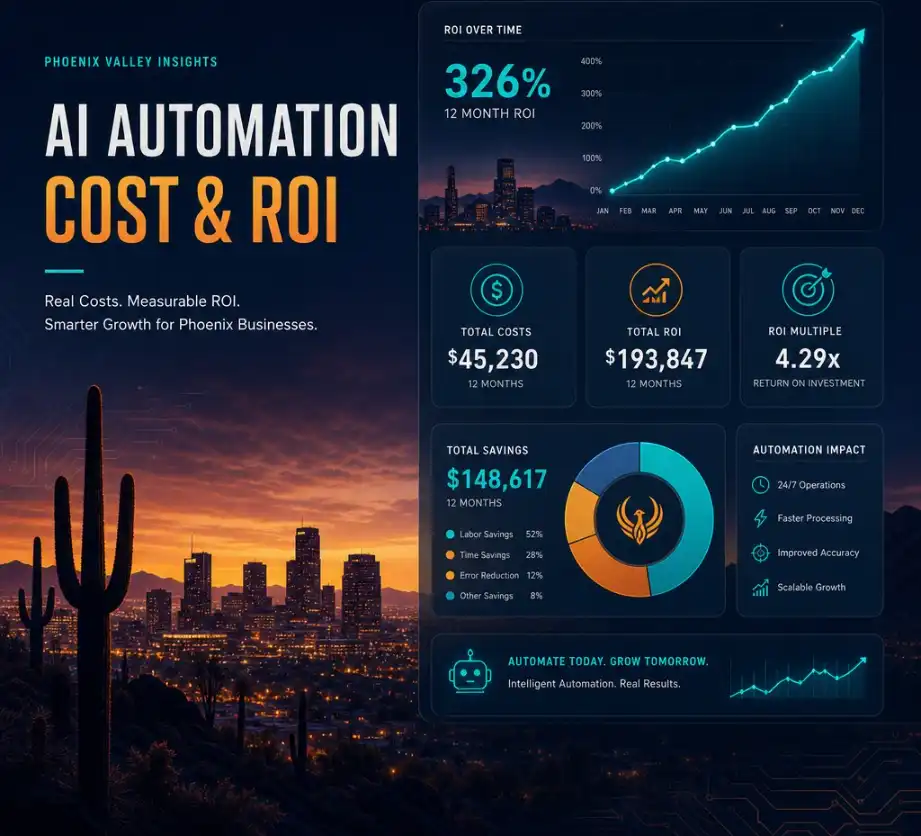
What AI automation costs at published rates, how to calculate ROI with a worked example — hours saved times hourly cost — and how long typical projects take to pay for themselves.
Most AI automation marketing treats ROI as a vibe — "work smarter," "save countless hours." Counting the hours is the entire job. This page is the arithmetic: our real prices, a worked example you can rerun with your own numbers, and honest payback math including the costs vendors leave off the slide.
This is the money chapter of our AI automation practice. One scope note: whether automation fits your business at all is a different question — that's the qualifying guide; this page assumes a fit and prices it.
Our published rates — $150/hr typical for AI work, $2,500 minimum engagement, 50% deposit against a signed Statement of Work, 20% buffer already built into estimates:
| Engagement | Range | Timeline |
|---|---|---|
| AI audit & strategy (map + priced roadmap) | $3,000–$8,000 | 1–2 weeks |
| Single workflow automation | $5,000–$25,000 | 2–6 weeks |
| LLM integration into existing tools | $6,500–$25,000 | 2–6 weeks |
| Document processing automation | $8,000–$30,000 | 3–8 weeks |
| Custom AI agent / chatbot | $15,000–$50,000 | 4–10 weeks |
| Ongoing operation | $500–$2,500/mo | ongoing |
The line vendors omit: operation is part of the price. Model usage costs money per call; integrated platforms change their APIs; business information drifts and the automation must drift with it. Any ROI math that prices the build and ignores the running cost is off by the amount that matters — so ours goes in the formula below, on the cost side, where it belongs.
The formula, plainly:
Annual value = (hours/week the task consumes) × (loaded hourly cost of whoever does it) × 52 × (fraction automation absorbs)
Compare against: build cost (year one) + annual operating cost.
Worked, with realistic Phoenix service-business numbers:
Say inquiry intake and follow-up consumes 10 hours a week across your office staff — reading, re-typing into the CRM, drafting replies, chasing follow-ups. Loaded cost (wage + taxes + benefits) for that work: $30/hour. An intake automation of the kind we build typically absorbs about 80% of it, leaving humans the approvals and exceptions.
Payback lands around month 15–16 on labor alone. After that, the recovered hours are simply yours, every year, while the operating cost stays flat.
Three honest adjustments that move the number — two up, one down:
Rerun the formula with your own three inputs — hours, loaded cost, absorption — and you have the only ROI figure that means anything: yours.
Across the pattern: well-chosen first automations reach payback in 6–18 months on labor alone — faster with revenue effects counted, faster still for document-heavy workflows where the before-state is pure re-typing. The audit's job is exactly this triage: mapping your workflows to the formula and sequencing them best-payback-first, so phase one's returns fund phase two.
What stretches payback past 24 months is almost never the build price — it's the target: low-frequency tasks, unstable processes, or broken workflows automated as-is (the classic failure — catalogued here). Which is why we'll walk the math with you before the deposit, with your numbers on the table: a project that doesn't clear the bar is a project we'd rather not build.
Because intake isn't every business's shape, the same formula on a document-heavy workflow: a small distributor processes roughly 60 supplier invoices and packing lists a week, each taking about 6 minutes of reading and entry — 6 hours weekly, at $28/hour loaded. A document processing automation absorbing 85% (documents are more uniform than emails, so absorption runs higher):
Notice what's different from the intake example: lower hours, higher absorption, and the error-cost term doing real work. Different workflows earn differently — which is exactly why the audit prices your workflows instead of reciting these.
Audits $3,000–$8,000; single workflows $5,000–$25,000; chatbots and agents $15,000–$50,000; operation $500–$2,500/month. All terms published, all quotes itemized.
Wage plus employer taxes, benefits, and overhead — typically 1.25–1.4× the wage for small-business staff. Using bare wages understates the return; using the owner's opportunity cost (for tasks the owner does) usually understates it more — founder hours spent on re-typing are the most expensive hours in the formula and the first ones worth buying back.
If one workflow is obviously the target and obviously stable, we'll quote it directly. The audit earns its fee when there are several candidates — sequencing by payback is worth more than any single build decision.
Model usage, monitoring, and adjustment as your tools and information change: $500–$2,500/month depending on volume and criticality, stated in the SOW, never discovered later.
Yes — wrong target, unstable process, or unpriced operation costs get you there. Every guard on this page (honest absorption rates, operation in the formula, the 24-month rule) exists because we've seen the wreckage of math done sloppily.
A sane first-year shape for a small business: the audit ($3,000–$8,000), one workflow build sized to your best target ($5,000–$25,000), and operation for the remainder of the year (~$500–$1,000/month at single-workflow scale) — call it $15,000–$40,000 all-in, with the second workflow decision deferred until the first one's real numbers arrive. What we'd steer you away from: committing to a multi-workflow program up front. The measured results of workflow one are the cheapest, most honest input to the workflow-two decision, and any vendor pressuring you to pre-commit past them is optimizing their forecast, not your return.
Only if you redeploy them — which is the owner's job, not the automation's. The hours are real; whether they become more billable work, faster response times, or shorter days is a management decision. The businesses happiest with automation decided in advance where the recovered capacity would go.
Want the formula run on your actual workflow? Bring the three inputs — hours, who does it, how consistent it is — and we'll do the arithmetic with you, no deposit required to hear the honest answer. Run the numbers with us, or check whether automation fits at all first.