MVP Builds for Phoenix Founders
What an MVP actually needs (and doesn't), our idea-to-working-product process, and what our own SaaS looked like at MVP stage — from a software engineering company that has shipped its own.
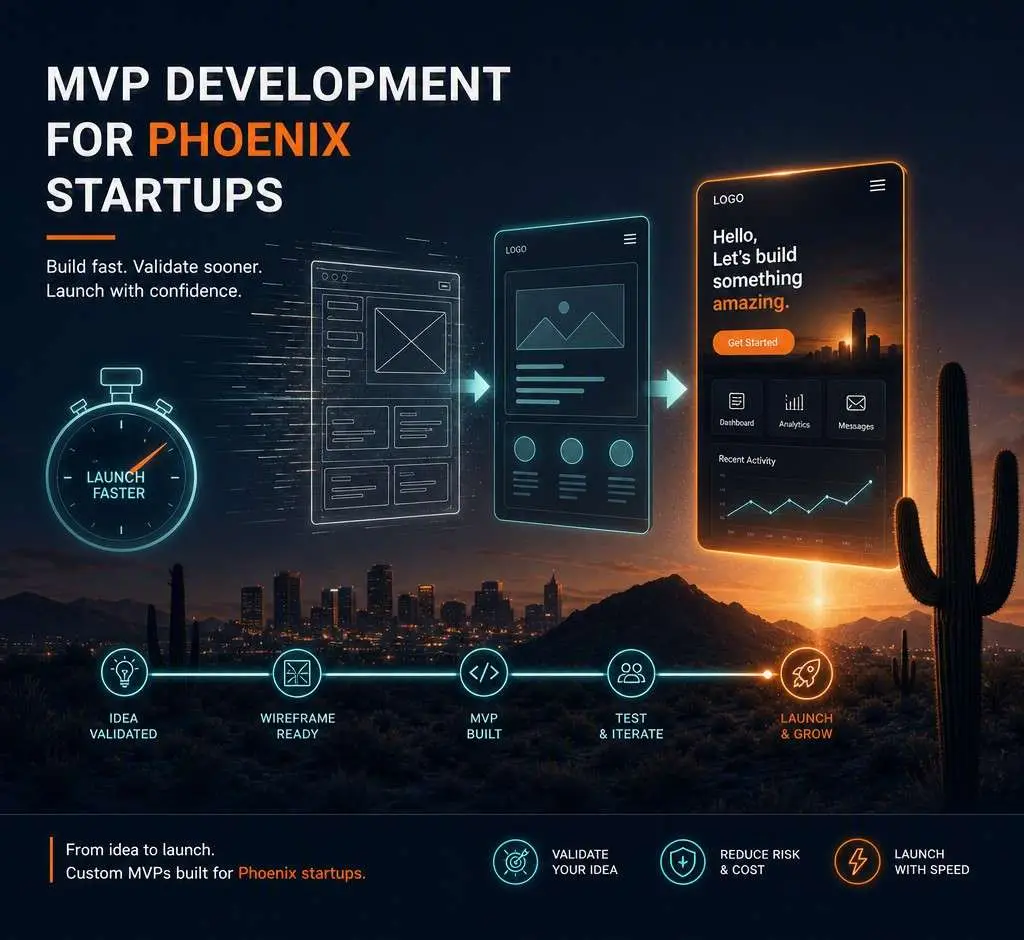
What an MVP actually needs (and doesn't), our idea-to-working-product process, and what our own SaaS looked like at MVP stage — from a software engineering company that has shipped its own.
Most MVP advice comes from people who've never shipped one. Agencies inflate the scope because bigger builds bill more; blog posts recite "build-measure-learn" without ever naming what to cut. This page is different for one reason: we've done this for ourselves, with our own money — our SaaS product Tonalyzer started exactly the way we're about to describe.
MVP work is the founder-facing end of our custom software practice, and the discipline below is the whole game.
An MVP — minimum viable product — exists to answer one question with real users before you spend real money on the full vision. Everything in the build either serves that question or delays it.
What it needs:
What it doesn't need (yet): admin dashboards (founders can query the database for the first fifty users), settings pages, the second and third user types, native mobile apps (a web app reaches every phone today), SSO and enterprise features, and scalability for a million users you don't have. Every one of these is buildable the moment evidence demands it — which is precisely why building them before evidence is the classic way founders convert $60,000 into a lesson.
The one-line test we apply to every proposed feature: "what decision changes based on this?" No answer, no build.
Week 0 — the cut. A working session that turns the vision into a hypothesis and a scope: what are we testing, who's the first user, what's the one workflow, and — the longer, more valuable list — what are we explicitly not building. Output: a Statement of Work with a fixed scope and a real number ($12,000–$35,000 for focused builds; SaaS MVPs with billing and multi-tenancy typically $25,000–$75,000, consistent with everything else we publish).
Weeks 1–2 — walking skeleton. The workflow end to end at minimum fidelity — thin, ugly, and real: sign up, do the thing, see the result. From this point forward there is always working software to click, which is your best defense against the six-months-of-silence failure mode that our partner-selection guide warns about.
Weeks 3–6 — flesh and instrumentation. The core loop gains the polish that removes friction from the signal, payments go in if payment is the question, analytics land on the events that matter.
Weeks 7–8 — production and first users. Deployed to infrastructure in your accounts, store-submitted if mobile, and in front of real users — with two weeks of fast-response support as the first data arrives, because the launch is the beginning of the experiment, not the end of the project.
You own everything — code, accounts, IP — from day one. If we're the wrong partner for phase two, you can leave with the whole product in hand, which is exactly the leverage a founder should keep.
Our proof isn't a client logo — it's a product you can use. Tonalyzer, our AI writing-analysis SaaS, is live and commercial today: eight detection engines, subscription tiers, bring-your-own-key support. Here's what it was at MVP:
A fraction of the detector count. One subscription path. An admin experience that was, honestly, us in the database console. What it did have: the core loop — paste text, get genuinely useful tone analysis back — working end to end, behind real authentication, on real infrastructure (the same Next.js/TypeScript/Supabase stack we build client MVPs on), with a way to pay.
That skeleton answered the only question that mattered — is the core analysis valuable enough that strangers engage and pay? — and everything since has been evidence-driven extension. The full build story, including what we'd do differently, is public, because a software engineering company selling MVP discipline should show you its own.
Patterns from the MVP conversations we've had — each one a budget leak with a name:
Building for the pitch instead of the user. Features added because they'll demo well to investors rather than because the first fifty users need them. Investors fund traction; traction comes from the core loop working; the demo-candy can be a slide. When the honest audience for a feature is a pitch meeting, it's marketing spend wearing an engineering invoice.
Paying for certainty that doesn't exist yet. Fixed-scope contracts for eight months of features, signed before the first user has touched anything. The whole point of the MVP sequence is that your feature list is a hypothesis — buying it all up front converts flexibility you need into commitment you don't.
The stealth-mode tax. Months of building in secret to protect an idea that, bluntly, is safe: execution is the moat, and feedback delayed is money burned. The MVP discipline is partly a schedule for meeting reality early, while reality is still cheap to meet.
All three have the same antidote — the "what decision changes based on this?" test, applied relentlessly, by a builder whose fee doesn't grow when your scope does. Our fixed-quote structure isn't just pricing hygiene; it's the incentive alignment that makes the ruthless-scoping advice believable.
$12,000–$35,000 focused, $25,000–$75,000 for SaaS with billing and multi-tenancy, at $150/hr typical. The cheapest lever is scope: features deferred are runway preserved.
The "what decision changes?" test, applied feature by feature in the Week-0 session — plus one structural rule: everything in scope must serve the single hypothesis being tested. Features serving a second hypothesis go on the phase-two list, however good they are, because two hypotheses in one build means neither gets a clean answer. Founders usually arrive expecting to fight for features and leave relieved someone finally helped them cut.
Sometimes — and when your test is "will anyone click this?", you should, for a few hundred dollars. Custom MVP territory begins when the product's value is the software: real logic, real integrations, an experience no-code can't credibly fake. The boundary is covered honestly in what is custom software.
Evidence-driven extension on the same codebase — an MVP built properly is the product's first version, not a throwaway. (And if it invalidates: you spent the minimum to learn it, which was the point.)
No — we're a fee-for-build engineering company, which keeps our advice unconflicted, including the advice "don't build this yet."
Small course corrections are what short cycles are for — that's free flexibility, and it's the point of seeing working software weekly. A genuine pivot (different user, different core loop) means stopping and re-scoping, which sounds painful and is actually the system working: you'd rather pivot a six-week build than a six-month one, and the fixed-scope SOW makes the decision explicit instead of letting the project drift into something nobody priced.
The launch-adjacent engineering, yes: the marketing site (that's Hub 1's territory), analytics instrumentation, payment wiring, and store submission where mobile is involved. Positioning, fundraising, and go-to-market strategy are yours — we're the build partner, and pretending otherwise would violate the whole unconflicted-advice premise.
Have an idea that needs to become software? Bring it — the first conversation is the cut: what's the hypothesis, what's the one workflow, what does version one really cost. Talk to us.