What Custom Software Actually Costs (2026 Phoenix Pricing)
Real custom software pricing, published: MVP vs. full-build ranges, what drives cost up or down, and why outsourcing firms quote so differently than a local software engineering company.
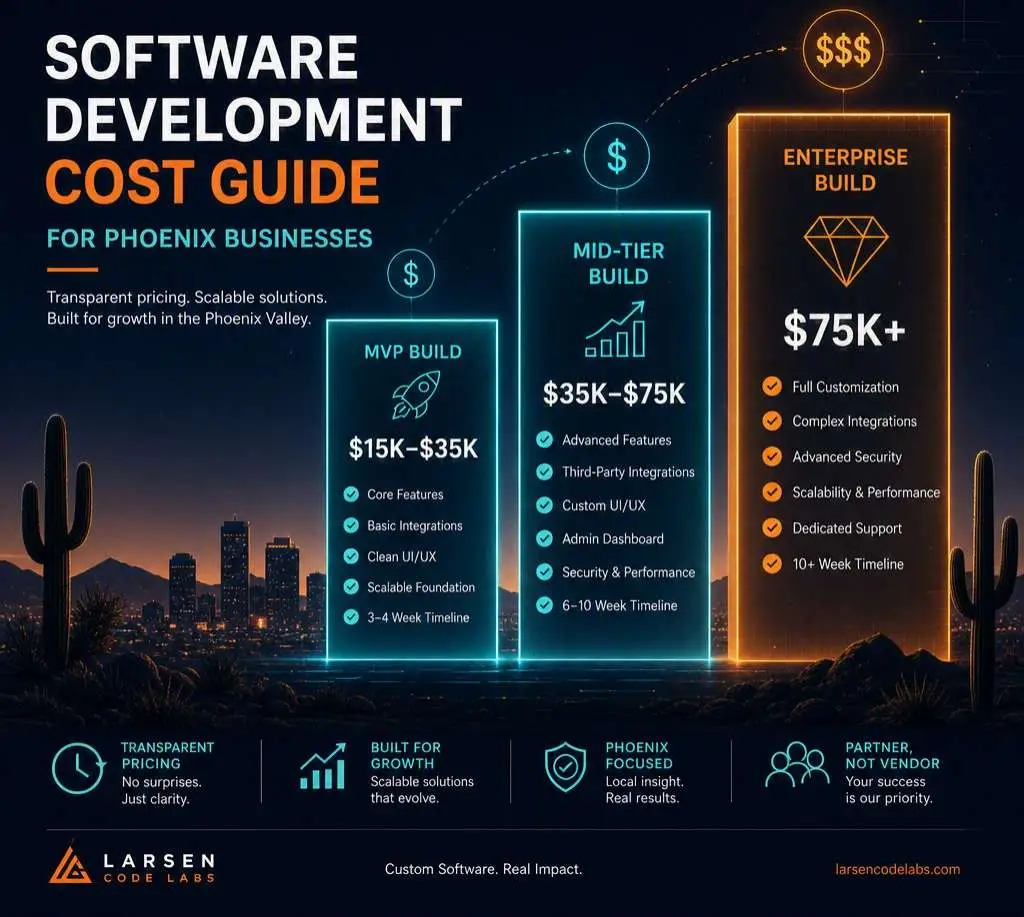
Real custom software pricing, published: MVP vs. full-build ranges, what drives cost up or down, and why outsourcing firms quote so differently than a local software engineering company.
Custom software pricing is famously opaque, and the opacity is a sales tactic: vague ranges keep you on the phone, and "every project is different" postpones the number until you're invested. Every project is different — and pricing can still be published, explained, and compared. Here's ours.
This is the money chapter of our custom software practice; the numbers below are the ones we actually quote.
At $150/hr typical, with a $2,500 minimum engagement, a 50% deposit, and a signed Statement of Work:
| Project type | Range | Timeline |
|---|---|---|
| Focused MVP (one platform, core features) | $12,000–$35,000 | 4–8 weeks |
| Custom web application | $18,000–$90,000 | 6–20 weeks |
| Customer/client portal | $20,000–$60,000 | 6–16 weeks |
| Native mobile app | $25,000–$75,000+ | 6–16 weeks |
| Cross-platform mobile app | $30,000–$90,000 | 8–20 weeks |
| Support & maintenance retainer | $1,500–$5,000/mo | ongoing |
One structural honesty note: we add a 20% buffer to every estimate before quoting, because software estimation is reliably optimistic and we'd rather the surprise be in your favor. The quote you sign is the quote you pay.
Five factors account for nearly all the variance between a $15,000 project and a $90,000 one:
The most useful budget decision isn't which number to pay — it's which sequence to buy in.
The MVP path ($12,000–$35,000): build the smallest version that produces real value — one core workflow, working end to end, in production. Then extend it with the things usage proves you need. This is how we build MVPs for founders, and it's how we built our own product: Tonalyzer shipped as a focused core and grew from there.
The full-build path ($40,000+): right when the workflow is well-understood, stable, and genuinely interconnected — replacing a mature system where a partial version can't run the business.
The pattern we steer clients away from: full-build pricing on MVP-level certainty. If you haven't run the process in software yet, you're guessing at half the requirements, and the expensive way to discover that is after they're built.
The same itemization discipline we apply to website pricing, applied here — composite budgets showing where software money actually goes:
A $28,000 internal tool (replacing a load-bearing spreadsheet: scheduling, quoting, or job tracking for a 10–30 person operation). Requirements discovery with the people who run the process: ~$3,500. Data model and architecture: ~$3,000. Core build — screens, roles, business rules: ~$13,000. One integration (typically QuickBooks or the CRM): ~$3,500. Migration of existing spreadsheet data: ~$2,000. Testing, deployment in your accounts, training: ~$3,000. Not included and not needed at this scale: native mobile apps, SSO, multi-region anything.
A $55,000 customer portal (clients log in to see status, documents, invoices; staff manage it from an admin side). Everything above at portal scale, plus authentication and roles done properly (~$6,000), the customer-facing polish tax — self-explanatory UI, empty states, error handling for the public (~$8,000), payment integration (~$4,000), and two systems integrated instead of one. This is also where support retainers stop being optional: customer-facing means incidents are business-visible.
Neither number is a quote — they're what quotes should look like inside. Any bid you can't decompose this way on request is a total in search of a justification.
Get three quotes for the same project and you might see $8,000, $45,000, and $250,000. Each number is rational from inside its business model:
The comparison that protects you is never the totals — it's the itemized scopes, side by side. Which is also the fastest way to expose a lowball: ask each bidder where data migration, integration error handling, and post-launch support appear in their number. Our full checklist for that conversation is in how to choose a development partner.
Before signing anything, anywhere, confirm each of these has a number or an explicit "not applicable" in the quote — they're the line items that turn a $30,000 project into a $50,000 surprise:
Our quotes carry all seven, itemized, because the vendors whose quotes don't are pricing the demo and back-billing the product.
With us: MVPs $12,000–$35,000, web applications $18,000–$90,000, mobile $25,000–$75,000+, at $150/hr typical. Elsewhere: anywhere from a fifth to five times those figures, for reasons the section above unpacks.
The ranges hold for the project shapes named; your position inside them comes from the five drivers, and a scoping conversation pins it to a real number in about an hour. What the ranges can't do is price a project nobody has scoped — which is why we'll never quote from a one-line email, and why you should distrust any vendor who will. A number produced without questions is a number produced for the salesperson's pipeline, not your budget.
Different purchases: the subscription rents average-fit software forever; the build buys exact-fit software you own. Over a 3–5 year horizon with per-seat pricing and workaround labor counted, the comparison is far closer than sticker prices suggest — the build-vs-buy piece walks the math.
Yes, three honest levers: cut scope (fewer features, fully built), phase the build (MVP now, extensions as proven), and simplify integrations (start with exports where a live sync isn't yet critical). The dishonest lever — cheaper hours — tends to buy the project twice.
$1,500–$5,000/month with us depending on criticality — details on the support retainer page.
Fixed price against a signed scope, for everything scopeable — that's what the 20% estimate buffer exists to make honest. Time-and-materials appears only where discovery is genuinely the work (exploratory audits, rescue triage), and it's capped in writing when it does.
$2,500 — typically a single integration, a focused audit, or a small tool. It's also the cheapest way to evaluate us before a bigger build, which is exactly how several of our larger projects started.
Want a real number for your project? Describe the workflow — we'll reply with an honest range, what's driving it, and the cheapest sequence to build it in. Get a quote.